January marked a strong start to 2026, with important infrastructure improvements, new partnerships, and community conversations across Ontology Network and ONTO Wallet. Below is a structured overview of what happened and why it mattered.
 Ontology Network Updates
January focused on network optimization, thought leadership, and strengthening the foundation for enterprise adoption.
A key milestone this month was the 80% reduction in MainNet gas prices, implemented on January 22 following community governance approval. This reduction significantly lowers transaction costs across the network, improving accessibility for developers and users alike.
On the thought leadership front, Ontology published articles exploring Web3 distribution evolution with a focus on trust and discovery, as well as insights on CeDeFi as a bridge between liquidity and self-custody. These pieces reinforce Ontology’s position as a thought leader in decentralized infrastructure. For broader context on these themes, a16z crypto explores how portable reputation is reshaping on-chain identity.
Additional highlights included:
2025 ecosystem expansion highlights showcasing growth across identity and DeFi verticals
Ongoing community governance participation in network parameter decisions
Continued infrastructure reliability and node performance monitoring
 Community Spaces in January
Web3 Unlocks Live Space exploring opportunities with ecosystem partners
These conversations provided insight into both technical developments and broader ecosystem direction.
 ONTO Wallet Highlights
January was an active month for ONTO Wallet, with new partnership integrations and trading campaigns driving user engagement.
The previously announced partnership with Changelly officially went live this month, expanding in-wallet exchange options for users. To celebrate the integration, ONTO launched a trading competition with a total prize pool of 5,400 USDT.
ONTO continued its focus on helping users navigate Web3 with confidence, maintaining its position as a trusted discovery wallet designed for clarity and security. As blockchain identity tools enter everyday life, self-custody wallets like ONTO play an increasingly central role.
 Network Activity Snapshot
As of January, the Ontology network has processed:
20,162,892 total transactions
This milestone reflects continued on-chain usage across the ecosystem.
 Looking Ahead
With gas costs significantly reduced and new partnerships in place, Ontology is well-positioned for continued growth in 2026. Industry analysts identify digital identity, regulation, and government adoption as pivotal Web3 trends this year, areas where Ontology’s infrastructure continues to deliver. The network remains focused on infrastructure reliability, ecosystem expansion, and community-driven governance.
Thank you for being part of the Ontology ecosystem. We look forward to sharing more updates in February.
Why This Matters
Transaction costs are one of the most significant barriers to blockchain adoption. For enterprises evaluating decentralized solutions, predictable and reasonable operational costs are essential for sustainable integration. For developers building the next generation of apps, lower gas prices mean more room to innovate and experiment.
Enhanced Accessibility: Lower transaction costs remove friction for new users and enterprises entering the ecosystem.
Developer Empowerment: Builders can deploy and test applications more cost-effectively, encouraging faster iteration.
Competitive Positioning: Ontology remains aligned with industry standards, offering compelling economics compared to other Layer 1 solutions.
Ecosystem Growth: Emerging apps benefit from a more cost-efficient environment, strengthening the overall Ontology ecosystem.
The upgrade is live now. Start building at ont.io
]]>This is where CeDeFi, the convergence of centralized and decentralized finance, is playing a growing role, particularly within non-custodial wallets.
Rather than replacing DeFi, CeDeFi is emerging as a complementary layer that helps bridge usability gaps without compromising user sovereignty.
Why CeDeFi Matters
Pure DeFi offers transparency and self-custody, but it can also introduce friction. Fragmented liquidity, complex interfaces, and variable execution outcomes can create barriers, especially for users navigating multiple chains or assets.
Centralized exchanges, on the other hand, offer deep liquidity and simplified execution, but often require users to relinquish custody and manage additional accounts.
CeDeFi combines elements of both models. It allows users to access centralized liquidity and pricing efficiency directly from a non-custodial environment, without transferring control of their assets to an exchange account.
For users, this means fewer steps and reduced operational risk.
For ecosystems, it means broader participation without lowering trust standards.
Non-Custodial Wallets as the Integration Layer
Non-custodial wallets are increasingly becoming the natural home for CeDeFi integrations.
From an architectural perspective, wallets already sit at the intersection of identity, assets, and transaction execution. Adding CeDeFi services within this context allows users to interact with centralized liquidity providers while maintaining self-custody and on-chain transparency.
In wallets such as ONTO Wallet, CeDeFi integrations enable users to:
- Swap or bridge assets across chains without depositing funds into an exchange account
- Retain full control of private keys throughout the transaction flow
- Access multiple liquidity providers through a single interface
The wallet becomes an orchestration layer, rather than a gatekeeper.
Partner Integrations in Practice
ONTO Wallet integrates with established CeDeFi partners to expand exchange options while preserving non-custodial principles.
Services such as Changelly, SimpleSwap, and Exolix provide access to aggregated liquidity and cross-chain execution, allowing users to complete swaps or bridges directly from within the wallet interface.
From an ecosystem perspective, these integrations:
- Reduce friction for users entering or moving within Web3
- Improve price discovery and execution reliability
- Allow wallets to offer flexibility without rebuilding exchange infrastructure
Importantly, these services operate as optional pathways, not mandatory dependencies. Users remain free to choose how and when they engage.
Trust, Control, and Optionality
CeDeFi is sometimes misunderstood as a compromise between decentralization and convenience. In practice, its value depends on how it is implemented.
When integrated into a non-custodial wallet:
- Custody remains with the user
- Execution is transparent
- Identity and compliance requirements can be applied selectively
- Risk is reduced through choice rather than restriction
This model aligns closely with Ontology’s broader approach to Web3 infrastructure, where trust is applied deliberately and proportionally, rather than universally enforced.
Looking Ahead
As Web3 adoption expands, users will continue to demand both autonomy and efficiency. CeDeFi, when embedded thoughtfully within non-custodial wallets, offers a practical path forward.
Rather than forcing users to choose between control and convenience, this approach allows both to coexist.
Ontology will continue supporting infrastructure and identity standards that make these integrations possible, while products like ONTO Wallet demonstrate how they can be delivered in practice.
]]>For builders and projects, this has created a new challenge:
distribution is no longer just about reach, it’s about trust, context, and quality of engagement.
ONTO Wallet’s evolution over the last 12 months offers a useful lens into where Web3 distribution is heading, and what partners should now expect from the platforms that sit between products and users.
From Reach to Relevance
In earlier phases of Web3, distribution often meant visibility at any cost. The assumption was simple: more users, more wallets, more impressions.
That model is breaking down.
As the ecosystem matures, users are more cautious, regulators are more attentive, and projects are more selective about where and how they onboard new participants. The signal-to-noise ratio matters.
ONTO’s development over the past year reflects this shift. Rather than optimising for volume alone, the focus has been on reducing friction, clarifying risk, and supporting informed exploration.
For partners, this signals a move away from raw exposure toward relevant, trust-aligned distribution.
Why Abstraction Is Now Table Stakes
Multi-chain is no longer a future state, it’s already the present. But while infrastructure has advanced quickly, user experience has lagged behind.
The work done inside ONTO to simplify multi-chain interaction, from clearer transaction summaries to smoother swaps and bridges, highlights an important reality for integrators:
If users have to understand your infrastructure to use your product, adoption will stall.
Abstraction is not about hiding complexity; it’s about owning it on behalf of users. Distribution platforms that fail to do this will increasingly become points of friction rather than enablers.
Trust Is a Product Feature
Security and identity are often discussed as compliance requirements or backend concerns. In practice, they are central to whether users feel confident engaging with new products at all.
ONTO’s emphasis on visible risk indicators, clearer approval management, and optional identity integrations reflects a broader shift:
Trust is no longer implied, it must be continuously reinforced.
For partners, this has two implications:
- Users are more likely to engage when risk is clearly communicated
- Platforms that surface trust signals reduce onboarding friction for everyone downstream
Ontology’s work on decentralized identity and verification underpins this approach, enabling trust to be applied where it matters, without becoming a barrier everywhere else.
Discovery as a Shared Responsibility
As the number of Web3 projects grows, discovery becomes a bottleneck — not because of scarcity, but because of overload.
ONTO’s evolution toward a more curated discovery experience reflects an important change in how distribution platforms are expected to behave. The role is no longer neutral plumbing; it is active guidance.
For projects, this changes the value of integration:
- Discovery is contextual, not random
- Users arrive with a clearer understanding of what they are engaging with
- Early access is paired with learning and expectation-setting
This results in higher-quality engagement, rather than transient attention.
What This Means for Partners
The maturation of ONTO Wallet is not an isolated product story. It is a signal of how Ontology views the future of Web3 distribution:
- Fewer, more meaningful integrations
- Users who explore intentionally, not opportunistically
- Trust and identity applied purposefully, not performatively
- Distribution that supports learning, not just liquidity
For partners, integrating into ONTO is not simply about being listed inside a wallet. It is about participating in an environment designed to reduce friction, align incentives, and support sustainable user engagement.
Looking Ahead
As Web3 continues to evolve, the platforms that succeed will be those that treat trust, abstraction, and discovery as first-class responsibilities, not afterthoughts.
Ontology will continue building the infrastructure that enables this shift, while ONTO delivers it in practice through real user experience.
For projects looking to reach users who are early, curious, and increasingly selective, the question is no longer whether distribution matters, but what kind of distribution you are choosing.
Work With Ontology
If you are building a Web3 product and are exploring:
- Wallet-based distribution
- Identity-enabled access or verification
- Early user discovery with clearer trust signals
We’re open to conversations about how integration into the Ontology ecosystem, including ONTO Wallet, can support your goals.
Learn about integrating with ONTO
]]>December marked a busy close to the year, with important infrastructure updates, ecosystem milestones, and community conversations across Ontology, ONTO Wallet, and the wider network. Below is a structured overview of what happened and why it mattered.
Ontology Network Updates
December focused heavily on infrastructure stability, long-term sustainability, and ecosystem alignment.
Early in the month, Ontology issued a mandatory MainNet v3.0.0 upgrade notice, requiring node operators to update by December 3 to avoid network disruption. This upgrade was accompanied by planned ONG supply adjustments around December 15, reinforcing Ontology’s commitment to predictable and transparent network operations.
To mark Ontology’s 8th anniversary, the team hosted a series of community discussions, including special Privacy Hour X Spaces focused on ecosystem progress and future direction, as well as Community Connect Spaces covering anniversary updates and broader Web3 trends.
December also saw Ontology join the Circle Alliance Program, opening the door for deeper collaboration around on-chain economies powered by USDC.
Additional highlights included:
- Publication of the House of ZK report, covering MainNet upgrades and ecosystem developments
- A new Consensus Round 266 summary, outlining yield performance and staking growth
- Announcement of Ontology & Me campaign winners, distributing 1,000 ONG based on community voting
- Launch of Ontello Beta, introducing a new social Web3 application with encrypted messaging and AI agents
Community Spaces in December
These conversations offered insight into both technical developments and broader ecosystem direction.
ONTO Wallet Highlights
December was also an active month for ONTO Wallet, with a strong focus on discovery, trading activity, and community participation.
ONTO published its 2025 Year in Review, reflecting on the product’s evolution into a trusted Web3 discovery wallet designed to help users explore projects with greater clarity and confidence. This was complemented by the launch of the Year in Review feature inside the app, along with a community sharing campaign offering rewards of up to 100 USDT.
ONTO also announced an official partnership with Changelly, expanding exchange options inside the wallet. The integration is scheduled to go live in January, with related campaigns to follow.
Trading activity remained strong throughout the month, including:
- Final leaderboards and winner announcements for the ONTO x Exolix Trading Competition
- Multiple trading lucky draw campaigns with rewards in USDT and ONG
- A new Exolix trading campaign offering a total prize pool of 4,400 USDT
In parallel, ONTO continued community education efforts, publishing guidance on non-custodial wallet security and promoting discussions on building sustainable Web3 communities.
Network Activity Snapshot
As of December, the Ontology network has processed:
20,149,529 total transactions and over 200 million ONT has been staked.
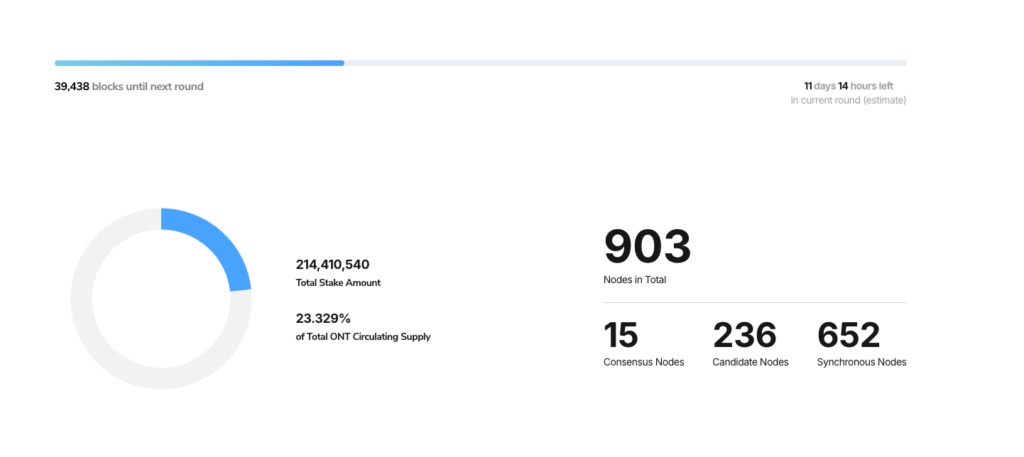
This milestone reflects continued on-chain usage across the ecosystem.
Looking Ahead
As the year comes to a close, Ontology remains focused on infrastructure reliability, responsible ecosystem growth, and long-term engagement models. More updates on upcoming initiatives and community programs will be shared in the new year.
Thank you for being part of the Ontology ecosystem. We look forward to continuing the journey together in 2026.
]]> Voting Period:
Start: 00:00 UTC, January 6
End: 00:00 UTC, January 9
The goal? Lower the cost of onchain transactions, improve usability for dApps, and unlock a smoother experience for developers and users across the ecosystem. With recent optimizations improving both consensus and gas handling, the network is ready for this change, without sacrificing performance or stability.
Lower gas = lower barriers. This proposal helps Ontology stay competitive with other L1s while empowering builders, users, and emerging dApps with a more cost-efficient environment.
 Node operators can vote now via OWallet. Every vote counts in shaping the next evolution of the Ontology network.
Why We Built Ontello
Ontello started from a simple belief:
Your conversations, your identity, and your digital actions should belong to you, not to a platform.
In the Ontello Beta, you will see the beginnings of that idea come together:
- A secure, end-to-end encrypted messenger
- A self-sovereign identity powered by ONT ID
- A built-in smart wallet that works with your device’s passkey
- A growing library of AI agents designed for Web3 life
What You Can Do in the Ontello Beta
Below is a practical overview of what works today and how you can try it.
Create Your Ontello Account (With Your ONT ID)
Your Ontello account begins with ONT ID, your decentralized identity.
It acts as your display name and your passport across the Ontello ecosystem.
You can customise your display name later, but your ONT ID is permanent.
Private, Encrypted Chat, Backed by On-Chain Identity
Ontello uses the Matrix protocol to deliver end-to-end encrypted messaging.
Because you sign in with ONT ID, every message is tied to a real, verifiable, self-owned identity.
To start a chat:
- Click + Create Chat
- Search for a contact by ONT ID or Matrix ID
- Begin your conversation, everything is encrypted by default
Your Smart Wallet, Automatically Created and Passkey-Secured
Ontello generates a self-custodial smart wallet automatically when you register.
No seed phrases.
No private key management.
No complexity.
Your wallet is secured by your device’s Passkey, the same authentication you use to unlock your phone. It is safer, easier, and avoids the common pitfalls of manual key storage.
In this beta release, the wallet supports: Ontology EVM (ONT, ONG)
You can send assets to ONT ID, ENS, or standard addresses.
Explore the AI Agent Store
One of Ontello’s early standout features is the AI Agent Store, a curated collection of agents built specifically for Web3 users.
In beta, you can:
- Browse available agents
- Chat with them directly
- Ask questions or perform simple on-chain actions (where supported)
Our Philosophy: Privacy, Identity, and Intelligence Should Belong to You
Ontello is built around a simple vision.
- Identity should be decentralized.
- Communication should be encrypted and interoperable.
- AI should empower individuals, not platforms.
This beta release is a first community step toward that vision.
]]>
This change is now live on mainnet following a decisive community vote.
After three days of on-chain voting between October 28 and October 31, 2025 (UTC), Triones nodes approved the ONG Tokenomics Adjustment Proposal with 117 million votes in favor and zero votes against.
This is one of the strongest expressions of community alignment in Ontology’s history.
With the mainnet upgrade complete, this announcement marks more than a technical update.
It reflects a cultural shift toward long-term sustainability, stronger liquidity, and a builder-first mindset.
Why This Matters for the Ontology Community
Ontology’s two-token system is designed for reliability and security:
- ONT powers governance and staking
- ONG fuels transactions, network usage, and contributor rewards
By permanently reducing ONG’s supply, this upgrade strengthens the long-term foundation of the ecosystem.
This vote was not just about token mechanics.
It was about the culture we want to build:
- A culture of clarity
- A culture of sustainability
- A culture where builders can trust the system to support their work for decades
The Key Changes, Clearly Explained
ONG Max and Total Supply Reduced to 800 Million
- 200 million ONG has been permanently burned
- Maximum and total supply is now fixed at 800 million ONG
This is a hard cap. No additional ONG can ever be created beyond this limit.
A tighter supply model creates a stronger foundation for long-term value, predictability, and confidence.
Circulating Supply Is Unchanged Today, but Will Reduce Over Time
There is no immediate change to circulating supply.
However:
- 100 million ONG worth of ONT and ONG is now being permanently locked through the new liquidity mechanism
- These assets are removed from circulation forever
Over time, this is expected to reduce effective circulating supply to approximately 750 million ONG, assuming 1 ONG ≈ 1 ONT.
This aligns with Ontology’s commitment to responsible token management and long-term supply discipline.
ONG Emissions Remain Stable and Predictable
ONG has always followed a steady, transparent release schedule.
To avoid a sharp increase in emissions near the end of the original schedule, the community approved a small extension.
Key points:
- ONG continues to release at 1 ONG per second
- The release period extends from 18 years to approximately 19 years
- The emission curve remains smooth and predictable
This ensures long-term stability for stakers, developers, and ecosystem partners.
The Core of This Upgrade: Stronger, Permanent Liquidity
Liquidity is not a technical footnote.
It is foundational to a healthy ecosystem.
A strong network is one where:
- Users can move assets with confidence
- Builders trust liquidity depth for real usage
- Developers avoid sudden market shocks
- Long-term contributors are protected from instability
How the New Liquidity Mechanism Works
- ONG is used to acquire ONT
- ONG and ONT are paired into liquidity provider (LP) tokens
- LP tokens are permanently burned
- The underlying assets are locked forever
This creates permanent, non-removable liquidity that strengthens Ontology’s DeFi and infrastructure layers.
The result is a more resilient market environment that builders can rely on.
Community Questions Answered
How long will the ONT and ONG equivalent to 100 million ONG remain locked?
Permanently.
Why was the release period extended?
To maintain a stable emission rate rather than increasing emissions sharply near the end of the original schedule.
Will ONT staking rewards change?
ONG emissions decrease slightly (around 20%).
However, tighter supply and stronger liquidity may improve long-term value for stakers.
How does this benefit the ecosystem?
With:
- A hard cap of 800 million ONG
- An immediate burn of 200 million ONG
- 100 million ONG permanently locked via burned liquidity
The token economy becomes healthier, more predictable, and more sustainable.
Who participated in the vote?
All Triones nodes voted via OWallet.
What Happens Next
The mainnet upgrade is complete, and all tokenomics improvements are now active.
Ongoing monitoring will focus on:
- Staking incentives
- DEX liquidity health
- ONG emission progress
- Long-term supply management
The rollout is designed to remain smooth and stable for all participants.
Building a Culture Builders Can Trust
This upgrade is not just about numbers.
It represents Ontology’s values:
- Predictability
- Sustainability
- Transparency
- Liquidity deep enough to support real activity
- A long-term mindset that respects both users and builders
Thank you to every community member and node that participated.
This decision sets the tone for Ontology’s next chapter.
We’re building for the long term — and we’re building it together.
]]>DID & Web3 Reputation — What Happened in November
• DIF Newsletter #55 Released
The Decentralized Identity Foundation (DIF) published its latest newsletter, exploring how DID and verifiable credential standards are being adapted for AI agents to enhance trust and identity in decentralized systems.
• Privacy and Social Trust in Web3
Bitget reported on UXLINK and ZEC’s collaboration to build compliant privacy and real-world trust networks, advancing Web3 reputation through human-centric systems.
What Ontology Did in November
• Whitepaper Saturday Launch
Initiated a weekly quiz based on Ontology’s whitepaper as part of the #ONTWeeklyChallenge, inviting the community to answer surprise Telegram questions for $ONG rewards and emphasizing deeper understanding over superficial reading.
• Meme Monday Activation
Launched the week’s challenge with a themed meme contest (“When you finally understand how staking works”). Participants submitted original memes tagged #OntonautsMeme and tagged 3 friends for a share of a $100 $ONG prize pool.
• Hodler Tuesday
Participants who held at least 10 $ONT / $ONG and shared proof in Telegram received rewards. The event also encouraged the community to prepare for Discussion Wednesday.
• Wordle Wednesday Event
Hosted a live Wordle-style discussion in Telegram with updated rules requiring reposts, tags, and form submissions to qualify for $ONG rewards.
• Swap Thursday
This week included:
- A minimum $10 token swap challenge via ONTO Wallet with screenshot submissions
- A new educational video on Proof of Stake
- A Privacy Hour Space focused on decentralized identity and Web3
- An announcement for a Community Connect on AI × Crypto
• Game Friday
Held a series of Telegram mini-games testing knowledge and reaction speed, with leaderboard rewards for top performers.
• Community Connect
Hosted multiple live Spaces discussing Web3 × AI × Crypto, and previewed the next Whitepaper Saturday.
• 8th Anniversary Campaign Kick-Off
Two major anniversary initiatives launched:
- Ontology & Me storytelling campaign
- Free Node Setup campaign
November Spaces
- Community Connect: https://x.com/OntologyNetwork/status/1986359985522049448?s=20
- Privacy Space: https://x.com/OntologyNetwork/status/1986458150753501674?s=20
- Community Connect: https://x.com/OntologyNetwork/status/1986359985522049448?s=20
- Privacy Hours: https://x.com/OntologyNetwork/status/1986458150753501674?s=20
- Community Connect: https://x.com/OntologyNetwork/status/1986645858209689845?s=20
- Community Connect: https://x.com/OntologyNetwork/status/1988897265621037193?s=20
What ONTO Wallet Did in November
• Trading Competition Update
Shared ongoing leaderboard updates for the Trading Competition with @SimpleSwap_io, encouraging users to keep trading to win from the 2,170 USDT prize pool (ending November 14).
• OKX DEX Integration
Announced full integration with @okx DEX, enabling ONTO Wallet users to access trending trading pairs directly within the dApp.
• Trading Competition Conclusion
Confirmed the competition’s end, published the winners list, and announced that rewards would be distributed within 7 working days.
• Invite Campaign Launch (8th Anniversary)
Launched a referral campaign offering 20 ONG per successful invite, drawn from a 10,000 ONG pool, running November 21 – December 21.
• Invite Campaign Access Instructions
Shared guidance on accessing the Invite Campaign through:
- Mobile browser
- Discover page banner
- ONTO Profile section
What Orange Did in November
• Rewards Distribution
Announced 20 lucky winners from the @humanode_io campaign on Orange, distributing $400 for bridging Biotoken on Ontology EVM.
• X Space Promotion
Highlighted an upcoming Space hosted by @digikaai on AI Agents, Smart Contracts & The New Digital Workforce.
• OHS Snapshot Announcement
Reminded users that one week remained before the OHS snapshot for Ontology’s 8th anniversary and encouraged minting OHS and reaching the top 10 ranks for a share of $1,000 ONG.
Staking & Statistics
- Total transactions to date: 20,105,312
That’s a Wrap for November!
Stay engaged as we continue shaping the future of Web3 together.
See you in next month’s edition!
 Also read
Your Guide to Joining the Ontology Node Campaign
This guide explains how holders can join Round 266 of the node campaign (running November 24 – December 12/13) and get a chance to have their node-setup fees reimbursed (2,500 ONG) if their node ends up among the top 5 by total stake. It outlines the full step-by-step participation process — from preparing 10,000 ONT, installing ONTO Wallet, to registering your node — and gives tips on how to attract delegators and increase your node’s stake.
8 Years of Trust: Your Ontology Story Begins Here
This celebratory post reflects on eight years of growth, community-building, and infrastructure development in the Ontology ecosystem — from decentralized identity and enterprise adoption to cross-chain integrations. It also introduces the anniversary campaign Ontology Life – Ontology & Me, inviting users to share their personal Ontology journey (first interaction, milestones, favorite moments) to win a share of a 1,000 ONG prize pool. The article paints a big-picture view of where Ontology has come from — and where it’s going.
]]>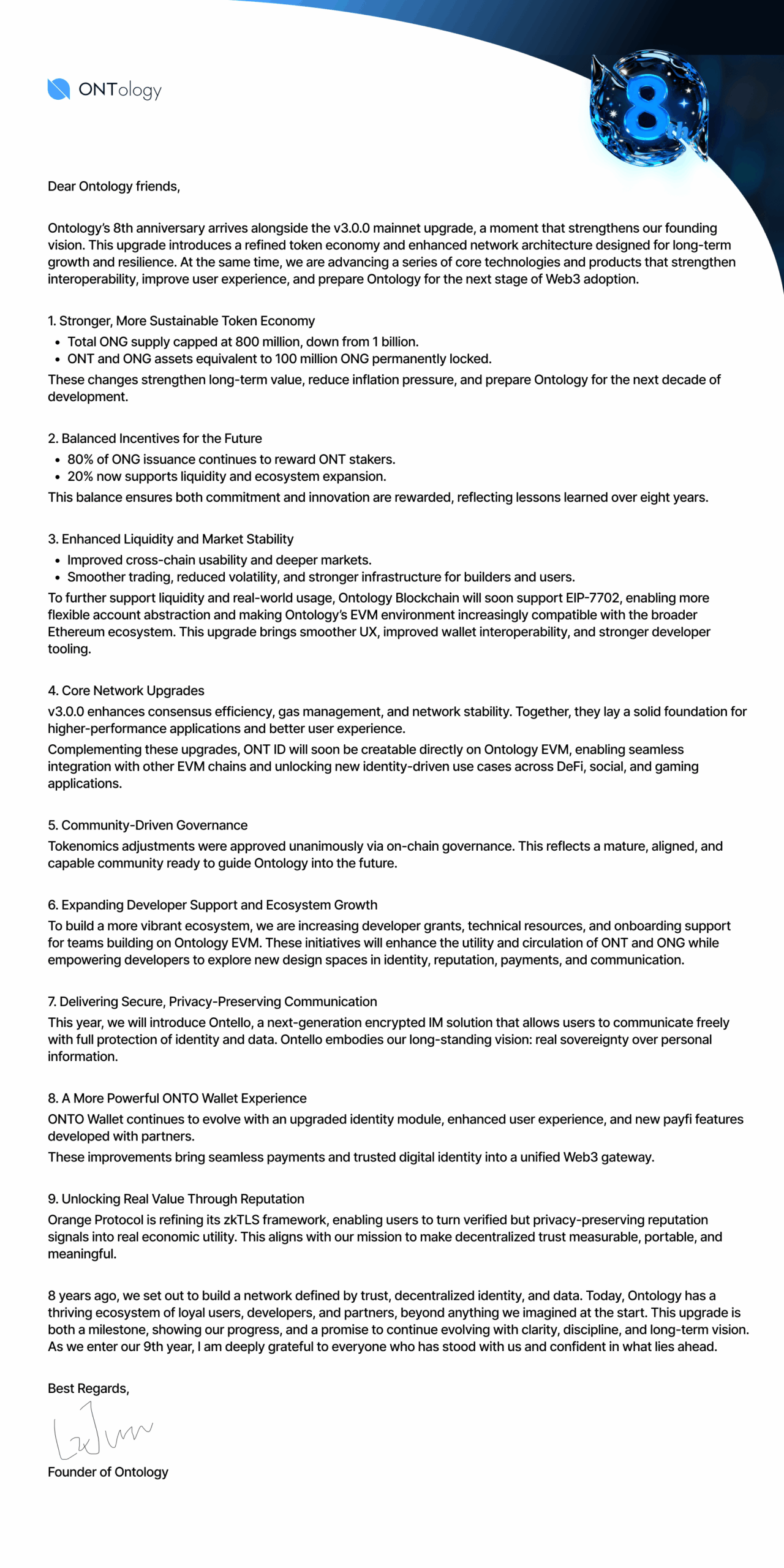
Key Highlights From Ontology’s v3.0.0 MainNet Upgrade
Strengthened Token Economy and Incentive Model
Ontology’s v3.0.0 upgrade introduces major improvements to Ontology’s dual-token model (ONT and ONG), designed to support long-term sustainability and ecosystem growth.
- The total ONG supply has been reduced from 1 billion to 800 million, with 100 million ONG permanently locked. This lowers inflation and strengthens long-term token value.
- Updated reward distribution now allocates 80% of newly issued ONG to ONT stakers and 20% to liquidity and ecosystem expansion, balancing network security with growth incentives.
These changes align Ontology’s token model with long-term utility and healthier economic design.
Network Upgrades, Identity Integration, and Governance
The v3.0.0 upgrade enhances the core performance, interoperability, and identity tooling of the Ontology Blockchain.
- Upcoming support for EIP-7702 will introduce a more flexible account system and stronger compatibility with the Ethereum ecosystem, improving cross-chain liquidity and builder experience.
- Core upgrades to consensus, stability, and gas management make the network faster and more reliable.
- ONT ID will soon be creatable directly on Ontology EVM, unlocking seamless decentralized identity use cases across DeFi, gaming, and social platforms.
- All tokenomics updates were approved through on-chain governance, reflecting a mature and aligned Ontology community.
These improvements position Ontology as a more interoperable, identity-driven, and community-governed Web3 infrastructure layer.
Product Enhancements, Developer Growth, and Real-World Utility
Ontology continues to expand its ecosystem with new tools, user experiences, and privacy-preserving features.
- Expanded grants, developer tools, and onboarding resources make it easier to build with ONT, ONG, and ONT ID.
- A new encrypted IM solution launching later this year will leverage decentralized identity and zero-knowledge technology to protect user sovereignty and secure communication.
- The ONTO Wallet has been upgraded with a refined identity module, better UX, and new payfi functionality developed with partners, improving Web3 payments and digital identity management.
- Orange Protocol is advancing its zkTLS framework to turn verified, privacy-preserving reputation signals into real economic utility — strengthening Ontology’s mission to make decentralized trust measurable and portable.
Recommended Reading
ONG Tokenomics Adjustment Proposal Passes Governance vote
The proposal secured over 117 million votes in approval, signaling strong consensus within the network to move forward with the next phase of ONG’s evolution.
Initial update about the upcoming MainNet v3.0.0 upgrade and Consensus Nodes upgrade on December 1, 2025. This release will improve network performance and implement the approved ONG tokenomics update.
8 Years of Trust – Your Story Campaign
The first campaign to kick off Ontology’s 8th anniversary celebrations. It shares updates from the 2025 roadmap along with details on how to win rewards just for sharing your story with Ontology. We want to hear from you!
Your Guide to Joining The Node Campaign
Everything you need to know about how to get involved in Ontology’s node campaign, including key dates and requirements.